
Lipedema, cellulite, and lymphedema: how to distinguish them and what to really do
Lipedema, cellulite, and lymphedema are often confused, but they are three
completely different conditions that require distinct therapeutic approaches. Cellulite is a
common and benign aesthetic concern, lymphedema is an accumulation of lymph due to a dysfunction of the
lymphatic system, and lipedema is a chronic adipose tissue disorder that is often
undiagnosed. This guide explains how to recognize each condition, what the real causes
are, and which treatments actually work, avoiding ineffective cures and wasting time.
03/02/2026
"I've tried everything, but my legs stay like this"
Stop for a moment and look at photos from ten years ago. It's not that you were "different." It was you, just with firmer, brighter, more... alive skin. The problem isn't aging. It's how the skin loses quality: collagen, elasticity, hydration, tone.
But if the problem is tissue quality, the solution cannot just be filling or blocking.
That is why in recent years aesthetic medicine has evolved toward a completely different approach: not masking, but regenerating.
Comparing the three conditions: what they really are
Cellulite: the aesthetic concern (not the disease)
What it is:
Cellulite is an alteration of the subcutaneous adipose tissue that creates the classic "orange peel"
appearance. It affects over 80% of women after puberty.
Causes:
Hormones (estrogen), genetics, circulation, water retention, low-grade inflammation.
It is not a disease; it is a female anatomical characteristic.
Symptoms:
Irregular skin appearance (dimples, nodules).
No significant pain.
Worsens with hormonal changes (cycle, pregnancy, menopause).
Symmetrical on both legs.
Where it appears:
Thighs, buttocks, hips, abdomen. Rarely arms.
Distinguishing sign: The skin has an irregular appearance, but there is no pain and it does not
progressively worsen over time.
Lymphedema: when lymph doesn't flow
What it is:
Lymphedema is an accumulation of lymph (protein-rich fluid) in the tissues caused by a
dysfunction of the lymphatic system.
Causes:
Primary: congenital malformation of the lymphatic system.
Secondary: damage to the lymphatic vessels (oncological surgery, radiotherapy, trauma, infections).
Symptoms:
Significant swelling (edema) starting distally (foot/ankle or hand/wrist).
Taut, shiny skin, difficult to "pinch."
Feeling of heaviness.
Can affect only one limb (asymmetrical). Worsens during the day, improves at night with legs elevated.
Positive Stemmer's sign (impossible to lift a fold of skin on the second toe).
Where it appears:
Legs, arms, rarely symmetrical.
Distinguishing sign: The swelling is soft initially, then becomes hard (fibrosis). Responds to
manual lymphatic drainage and compression.
Lipedema: the invisible disease
What it is:
Lipedema is a chronic adipose tissue disorder characterized by an
abnormal and symmetrical accumulation of fat mainly in the legs and sometimes in the arms. It is a
real disease, not just being "overweight."
Causes:
Unknown, but strongly hormonal (often starts at puberty, pregnancy, or
menopause) and genetic. It affects almost exclusively women.
Symptoms:
Disproportionate accumulation of fat on the legs (and/or arms) compared to the trunk.
Spontaneous pain upon pressure and trauma (easy bruising).
Feeling of heaviness, tension, "tired" legs.
Palpable nodules in the adipose tissue.
Symmetrical (both legs).
Feet remain thin ("cuff sign" or "excluded foot").
Diet and exercise reduce body weight but not leg volume.
Progressive over time (worsens if untreated).
Where it appears:
Thighs, legs, ankles (but feet spared), buttocks, arms (but hands spared).
Distinguishing sign: The tissue is painful, the disproportion is evident, and diet and sport do not
work on the affected areas.
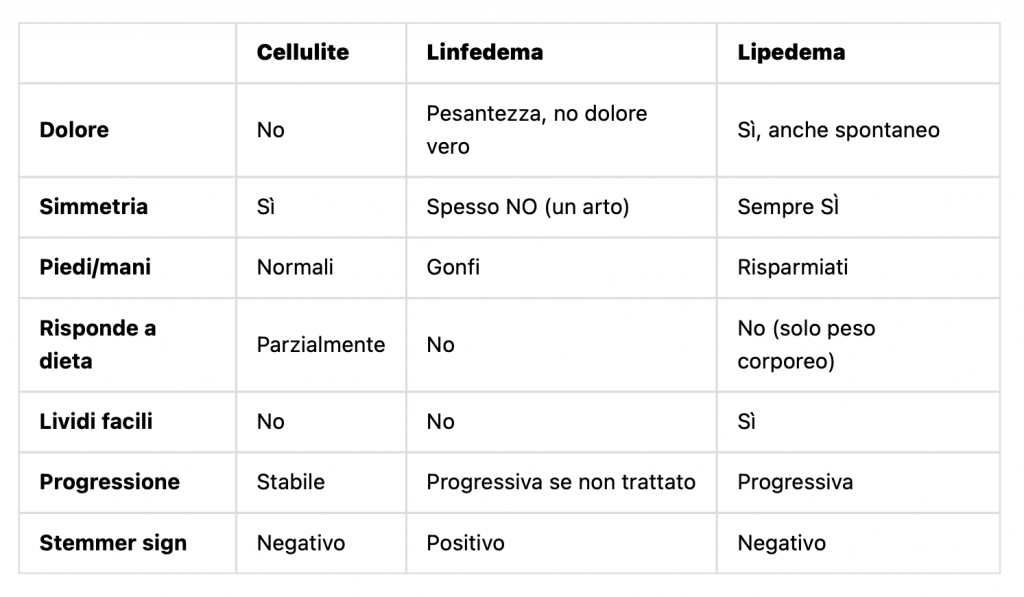
How to distinguish them: the practical table
Lipedema: the diagnosis that changes everything
Lipedema is the most underdiagnosed condition of the three.
Why?
Because it is mistaken for:
- "You're overweight, you need to eat less."
- "It's just cellulite."
- "It's water retention."
- "Your legs are like that because of genetics."
And women with lipedema spend years (often decades) being told they "aren't
trying hard enough."
The 4 stages of lipedema
Stage 1: Skin still smooth, increased fat but small and invisible nodules. Mild pain.
Stage 2: Irregular skin, palpable nodules, hardened tissue. More evident pain.
Stage 3: Fat hardened into plaques, evident deformities, reduced mobility. Constant pain.
Stage 4 (lipo-lymphedema): Lipedema damages the lymphatic system, also causing
edema. Most severe condition.
The earlier the intervention, the better.
What DOES NOT work (and why you continue to waste time)
For cellulite:
❌ "Miracle" creams (no cream penetrates deeply enough)
❌ Aggressive massages (worsen inflammation)
❌ Extreme diets (cellulite is not excess fat)
For lymphedema:
❌ Diuretics (worsen the situation)
❌ Ignoring the problem (it progresses and becomes complicated)
❌ Generic massages (specific manual lymphatic drainage is needed)
For lipedema:
❌ Restrictive diets (they don't reduce lipedema, only overall weight)
❌ Excessive sport (worsens inflammation and pain)
❌ Traditional liposuction (can damage lymphatic vessels)
❌ Ignoring symptoms hoping they will go away
5. Profhilo: the hyaluronic acid that regenerates
What actually works
Cellulite: realistic management
✅ There is no "definitive cure," but it can be improved:
✅ Combined treatments: radiofrequency, laser, shock waves (improve microcirculation)
✅ Anti-inflammatory diet: sugar reduction, increased omega-3, hydration
✅ Consistent physical activity: improves circulation and muscle tone
✅ Hormonal management: in menopause, HRT can help
✅ Targeted supplements: centella, bromelain, butcher's broom (microcirculation support)
✅ Realistic goal: visible improvement, not total disappearance.
Lymphedema: complex decongestive therapy
✅ Lymphedema is managed, not cured:
✅ Manual lymphatic drainage (MLD): a specific technique, not just any massage
✅ Multi-layer compression bandaging: fundamental
✅ Custom-made compression garments: after the decongestive phase
✅ Adapted physical exercise: with compression, it improves drainage
✅ Skin care: infection prevention (erysipelas)
✅ Sequential pressotherapy: drainage support
✅ Essential: constant follow-up with a lymphology specialist.
Lipedema: multimodal approach
✅ Lipedema requires specific and multidisciplinary treatment:
✅ Decongestive therapy: lymphatic drainage, compression (reduces inflammation and pain)
✅ Anti-inflammatory diet: low glycemic index diet, inflammation reduction
✅ Moderate physical activity: swimming, water aerobics, walking (avoid high-impact sports)
✅ Hormonal management: endocrinological evaluation, possible HRT in menopause
✅ WAL (Water-Assisted Liposuction): the only effective technique to reduce volume, preserves lymphatic vessels
✅ Psychological support: the disease has a strong emotional impact
✅ Important: Lipedema is not treated with diet or sport alone. A specific medical approach is needed.
When to see a specialist
Signs that it's not "just cellulite":
🚨 Legs are painful to the touch
🚨 You bruise easily without obvious trauma
🚨 Legs are disproportionate to the rest of the body
🚨 Diet and sport do not change leg volume
🚨 Feet remain thin while ankles are thick
🚨 Swelling is asymmetrical (one limb more than the other)
🚨 Swelling worsens during the day
If you recognize these symptoms, a specialist medical evaluation is needed.
Who to contact:
- Angiologist/Phlebologist: for circulatory and lymphatic evaluation
- Lymphologist: specialist in lymphatic system disorders
- Endocrinologist: for the hormonal component (especially in lipedema)
- Vascular surgeon: for advanced lipedema (WAL liposuction)
The truth you need to know
If you have tried "everything" and your legs remain swollen, painful, and disproportionate, the problem is probably not a lack of willpower. It is a lack of a correct diagnosis. Cellulite is a common aesthetic concern. Lymphedema is a lymphatic system disorder. Lipedema is a chronic adipose tissue disease. Three different conditions. Three different approaches. Three different results. You cannot treat what you haven't correctly diagnosed.
Want a complete evaluation?
At Studio Bonaccorso, we evaluate lipedema, lymphedema, and vascular issues with an integrated approach: clinical, hormonal, and personalized therapeutic.
Book a specialist consultation
Dr. Michele Bonaccorso
Studio Bonaccorso è a disposizione
per rispondere a tutte le domande.
Studio Bonaccorso is available to answer all questions.
BLOG
Regenerative aesthetic medicine: beyond Botox, there is another way to rejuvenate
Regenerative aesthetic medicine doesn't mask the signs of aging: it addresses them at the root. Through advanced technologies such as Thermage FLX, Zaffiro Laser, Exosomes, PRX-T33, and Profhilo, it is possible to stimulate the natural production of collagen and elastin, improving skin quality from the inside out. It's not about "freezing" or "filling," but about making the skin behave like young skin again, with natural, progressive, and long-lasting results. This comprehensive guide explains how each technology works, who it is for, and how to combine them into personalized protocols.
Menopausal Insomnia: Why You Always Wake Up at 3 a.m. (and How to Finally Sleep Well)
You wake up at 3 AM, your mind races, and by morning you're already exhausted.
In menopause, it's not "just stress": declining estrogen and progesterone and dysregulated cortisol disrupt sleep, blood sugar, and circadian rhythm.
Chronic insomnia worsens mood, metabolism, memory, and cardiovascular risk.
Herbal teas and melatonin alone often aren't enough.
Replacement Hormonal Therapy: What to Evaluate Before You Start (The Checklist No One Gives You)
Hormone Replacement Therapy (HRT) is not a standard prescription for menopause symptoms, but a complex therapy that requires a thorough evaluation. Hormones affect metabolism, the heart, brain, bones, liver, and blood clotting: starting without clinical data means exposing yourself to ineffectiveness or avoidable risks.
Before HRT, it is essential to analyze hormonal balance, thyroid function, stress, glucose metabolism, inflammation, liver health, thrombotic risk, gynecological and breast health, the cardiovascular system, nutritional status, and lifestyle.
Only personalized and monitored HRT can improve symptoms and become a long-term prevention tool. The right question is not "Should I do HRT?", but "Have I been fully evaluated before starting?"
Regenerative aesthetic medicine: beyond Botox, there is another way to rejuvenate
Regenerative aesthetic medicine doesn't mask the signs of aging: it addresses them at the root. Through advanced technologies such as Thermage FLX, Zaffiro Laser, Exosomes, PRX-T33, and Profhilo, it is possible to stimulate the natural production of collagen and elastin, improving skin quality from the inside out. It's not about "freezing" or "filling," but about making the skin behave like young skin again, with natural, progressive, and long-lasting results. This comprehensive guide explains how each technology works, who it is for, and how to combine them into personalized protocols.
Menopausal Insomnia: Why You Always Wake Up at 3 a.m. (and How to Finally Sleep Well)
You wake up at 3 AM, your mind races, and by morning you're already exhausted.
In menopause, it's not "just stress": declining estrogen and progesterone and dysregulated cortisol disrupt sleep, blood sugar, and circadian rhythm.
Chronic insomnia worsens mood, metabolism, memory, and cardiovascular risk.
Herbal teas and melatonin alone often aren't enough.
Replacement Hormonal Therapy: What to Evaluate Before You Start (The Checklist No One Gives You)
Hormone Replacement Therapy (HRT) is not a standard prescription for menopause symptoms, but a complex therapy that requires a thorough evaluation. Hormones affect metabolism, the heart, brain, bones, liver, and blood clotting: starting without clinical data means exposing yourself to ineffectiveness or avoidable risks.
Before HRT, it is essential to analyze hormonal balance, thyroid function, stress, glucose metabolism, inflammation, liver health, thrombotic risk, gynecological and breast health, the cardiovascular system, nutritional status, and lifestyle.
Only personalized and monitored HRT can improve symptoms and become a long-term prevention tool. The right question is not "Should I do HRT?", but "Have I been fully evaluated before starting?"